


 "My family and I have been with this practice since 2009. It sure is an amazing practice with great service and amazing staff. My experience has always been phenomenal. I would definitely recommend Lancaster House Dental Practice!"
C. Candice
Our practice
We take great pride in the quality of our dentistry and strive to make your visits a pleasant experience. Located in South Norwood, London, our aim is good health for you and your family through preventative dentistry. With onsite parking, we make sure that we are accessible for all our patients.
We tailor our treatment just fir you!
Using state of the art technology and high-quality dentistry, we use personalised prevention programmes made specially just for you. Adult restorative and cosmetic dental services, are just a few of the many services we offer, each designed to extend the life and beauty of your teeth.
We have been providing high-quality service for over 26 years, and have a team with over 102 years of combined dental experience. We are still treating patients who joined us back in 1991!
As a practice we:
- Listen - to our patients, creating personalised treatment plans just for them
- Are affordable - offering the best price for your amazing smile, with incredible quality service
- Are inclusive - treating all of our patients equally
- Create confidence - in yourself, after receiving treatment to build your new smile
- Adhere to all dental rules
- Support nervous patients in a comfortable and warm environment
- Ensure trust is built between every staff member and patient
- Are enthusiastic and employ passionate staff who all love what they do and are continously educating themselves
- Are ready to work with you and your needs
 Q. Why should I consider white fillings?
A. Most people have fillings of one sort or another in their mouths. Nowadays fillings are not only functional, but can be natural looking as well. Many people don't want silver fillings that show when they laugh or smile because they are more conscious about the way they look.
Q. Are they expensive?
A. Because many white fillings are only available privately, costs can vary quite a lot from dentist to dentist. Costs usually depend on the size and type of white filling used and the time it takes to complete the treatment. Costs may also vary from region to region.
Q. Are they as good as silver amalgam fillings?
A. There are now new materials available with properties comparable to silver amalgam, and these are proving to be very successful. The life expectancy of a white filling can depend greatly on where it is in your mouth and how heavily your teeth come together when you bite. Your dentist can advise you on the life expectancy of your fillings.
Q. Is it worth replacing my amalgam fillings with white ones?
A. It is usually best to change fillings only when your dentist decides that an old filling needs replacing. If so you can ask to have it replaced in a tooth-coloured material.
Q. What are tooth-coloured fillings made of?
A.This can vary, but they are mainly made of glass particles, synthetic resin and a setting ingredient.
 Dentures are prosthetic devices used to replace missing teeth with artificial teeth. Commonly they are known as a plate or false teeth. They are removable to allow for easy cleaning. They have many advantages as they can be used to have better aesthetics as well as better chewing ability and helping improve speech.
Q. How long does it take to get my dentures?
A. It takes around 3 appointments to receive your personalised dentures.
Upon your first appointment, you will discuss the process involved with your dentist via consultation appointment. Your dentist will then take primary impressions (moulds) of the teeth are taken for analysis by the laboratory.
Depending on the complexity of the case, a registration of the teeth position when biting will be taken. During your second appointment, a second set of more accurate moulds are taken. Occasionally a wax mock-up of the denture will be made to make sure they fit correctly and look as they should.
The denture is made by the lab and in your third appointment, will be fitted by the dentist occasionally easing any areas which may irritate the gums/cheeks.
Q. How do I look after my dentures?
A. Dentures should always be stored carefully and be cleaned regularly. It is important to keep dentures wet all the time, and to regularly brush the dentures in soapy water and on occasion leave then in a sterilizing solution.
Q. What type of dentures are there?
A. There are many types of denture; each made to custom-fit every individual patient. Please ask your dentist which type would suit you best.
 Q. Why should I replace missing teeth?
A. Your appearance is one reason. Another is that the gap left by missing tooth can mean greater strain on the teeth at either side. A gap can also mean your 'bite' is affected, because the teeth next to the space can lean into the gap and alter the way the upper and lower teeth bite together. This can then lead to food getting packed into the gap, which causes both decay and gum disease.
Q. How are missing teeth replaced?
A. This depends on the number of teeth missing and on where they are in the mouth. The condition of the other teeth also affects the decision.
There are three main ways to replace the missing teeth. The first is with a removable false tooth or teeth - a partial denture. The second is with a fixed bridge. A bridge is usually used where there are fewer teeth to replace, or when the missing teeth are only on one side of the mouth. The third is with dental implants.
Q. Can I always have a bridge to replace missing teeth?
A. Yes, if you have enough strong teeth with good bone support and the teeth are not too tilted. Your dentist will help you decide which is the best way of replacing the teeth within your budget.
Q. What are bridges made of?
A. Bridges are usually made of a precious metal base. If the bridge will show, porcelain is then bonded to the base. Sometimes, there are other non-precious metals used in the base to reduce the cost.
Q. Are bridges expensive?
A. Although a bridge may seem expensive it will last many years. It will also improve your appearance and bite. A bridge uses the considerable skill of the dentist and technician, and in this way, it's like ordering a piece of hand-made jewellery. The materials are also expensive so it's fair to say a bridge will not be the cheapest treatment you have ever had.
Q. How do I look after my bridge?
A. You need to clean your bridge every day, to prevent problems such as bad breath and gum disease. You must clean under the false tooth every day. Your dentist or hygienist will show you how to use a bridge needle or special floss, as a normal toothbrush cannot reach.
Q. Are there other methods for fixing false teeth?
A. There are other methods, such as using a combination of crowns and partial dentures that can keep the retaining clips out of sight.
These are quite specialised dentures, so you should ask your dentist about them. You can also have teeth implanted, ask your dentist for more information.
Remember that it's as important to care for your remaining teeth as it is to replace the missing ones.
Q. Are there different types of bridge?
A. Yes, there are different types of bridge which use different fixing methods. Your dentist will choose the most effective and conservative bridge for your personal situation.
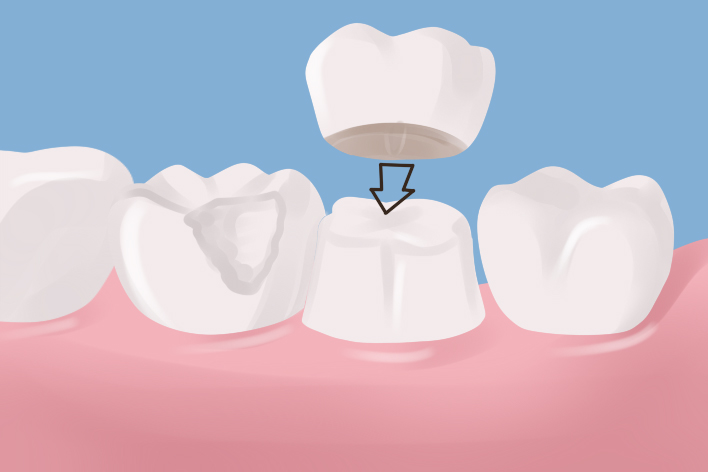 Q. What are they?
A. Crowns are made of metal, or porcelain, or porcelain with metal inside for strength. If a tooth has been weakened a lot by decay or other damage, a crown can protect it. It completely covers the tooth above the gum line.
A crown can also improve appearance if a tooth is misshapen or discoloured.
Q. What does the dentist do?
A. The tooth is shaped first. The crown needs to fit over the tooth easily without making it bulky; preparation time will depend on how damaged the tooth is. If there is not much natural tooth left, the tooth might be root-filled - this is sometimes called 'removing the nerve'. Then the tooth is built up with a filling, which might be held in place by a peg in the root canal. Preparation would then take more than one visit;
Soft material like putty is used to record the exact shape of the tooth to be crowned and the nearby teeth. A dental technician uses this 'impression' to make the crown the right size and height. The edge of the crown will normally be very close to the gum. A thin cord is used to hold the gum away from the neck of the tooth so that the impression is accurate round the edges;
A temporary crown will be put over the tooth until the crown is made. You can chew on a temporary crown but it won't be as strong as the permanent crown. Temporary crowns are made of plastic or metal;
When the permanent crown is fitted, small adjustments will be made to ensure that you can bite comfortably. The crown is tried on, first, and then fixed permanently.
Q. What are the benefits?
A. A crown is strong and can look and feel almost exactly like a natural tooth.
The colour and shape can be matched to your own teeth.
Depending on the strength of the tooth underneath, a crown can last for many years if your oral hygiene is good and the crown is not accidentally damaged.

